
We’ve all been there before. It’s late at night, and you’re cramming for an upcoming test or an exam, or even just working on an assignment you’ve been putting off. Or maybe you haven’t been there, maybe instead you’ve been up all night playing video games, watching a movie, or spending time with friends. Either way, there have been times in everyone’s life when they have either not gone to sleep when they were supposed to or didn’t give themselves enough time to sleep. Perhaps you’ve realized this mistake and have done your best to go to bed at what you think is a reasonable hour and attempted to get eight hours of sleep. But in the morning, you still feel groggy, irritable, and like you can’t accomplish anything. It’s time to realize that there are aspects of sleep that are important for getting good quality sleep beyond just sleeping. Good-quality sleep is important for a person to perform at their best. Quality sleep improves focus, decision-making, creativity, mood, reduces stress, and helps with learning. Following these tips can help you achieve quality sleep.
Importance of Sleep Stages
During sleep, your brain and body undergo a series of different stages. Of these stages, there are two main phases of sleep, REM and Non-REM sleep. REM is given this title as it refers to the point of sleep where Rapid Eye Movement (REM) happens, while non-REM, sometimes abbreviated as NREM, refers to the periods throughout the sleeping states during which rapid eye movement is not occurring. Each rotation between these phases is considered a cycle, Figure 1 presents what a cycle might look like. During an average night’s sleep, you may enter a cycle four to six times while asleep, depending on the quality of sleep you’re getting and how long you sleep (1).
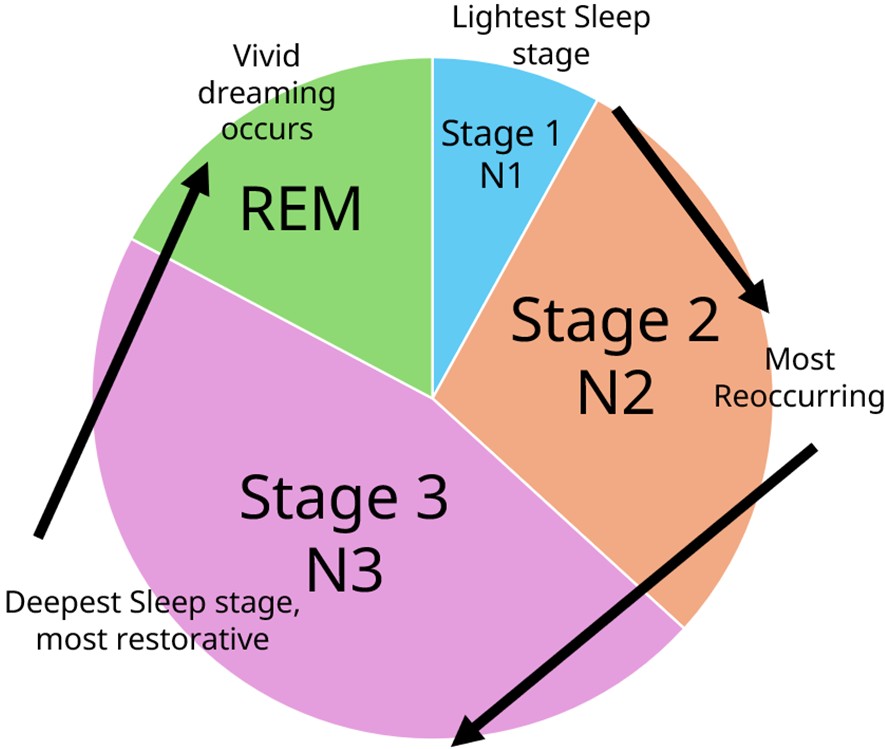
The earliest phase of sleep that typically occurs once in a cycle, as long as waking does not occur, is the lightest sleep stage. During the lightest sleep stage, the body transitions between wakefulness and into sleep; it is one of the three stages that make up the NREM sleep phase called N1. As you transition from waking to sleep in N1, your body lowers your heartbeat, breathing, and eye movement; your muscles slightly relax during this phase as well. The sleep stage your body enters the most often, especially as sleep cycles repeat throughout the night, is N2 (2). After N1, your heartbeat and breathing become even slower than before. As you enter N2, your muscles are also completely relaxed. The deepest sleep period is the most important, called the N3. To feel the most well-rested in the morning after a night’s sleep is necessary to sleep long enough so that your body enters the N3 stage of sleep. It takes around 30 to 45 minutes to enter the N3 stage of sleep, and N3 typically lasts 20 to 40 minutes during each sleep cycle(3,4). Of the stages that make up the sleep cycle, N3 is the longest, most restorative stage. N3 is considered restorative as during this stage, the body releases growth hormone, which aids in converting stored fat from food into energy for the body and into sugar for the brain, to return the body to a more physically productive state to be useful during the wake cycles(5). During REM sleep, considerable shifts ensue, such as increases in body temperature, breathing, and heart rate (6). REM sleep also involves a brief natural form of muscle paralysis; through this paralysis, the body prevents you from acting out your dreams (7). Dreaming occurs throughout all sleep stages; however, during REM sleep, dreams become longer, more vivid, and emotional (8,9). It’s important that throughout the night you give yourself enough time that you’re able to go through multiple cycles, usually four to six, in a night to feel the most well-rested in the morning. Times between stages and during stages may vary, it’s best to give yourself seven to eight hours a night to rotate between enough sleep cycles (10).
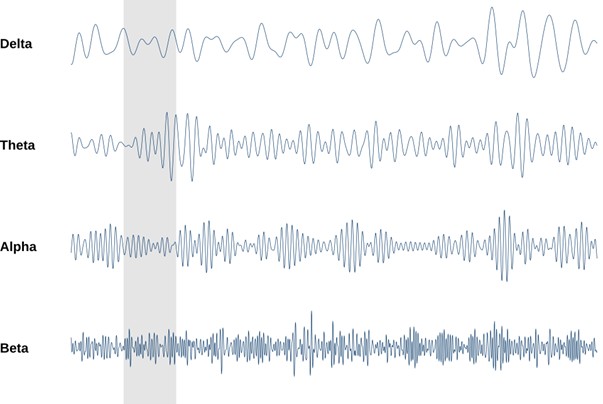
Sleep stages have been determined based on the behavioral changes that occur during each stage, as well as the amplitude or height of a brain wave produced during each point of sleep. Imagine as though your brain is an expansive ocean, the ocean produces a series of waves that change in shape depending on levels of arousal. Neurons within your brain communicate together, and when enough communication occurs, a wave is produced(11). Figure 2 presents what a few of these waves may look like. More communication can lead to both more waves and higher waves. As you fall asleep, the ocean begins to ease, resulting in very few waves that are not very tall. The waves produced in your brain have different names depending on how high or how close together they are. Before sleeping, the neurons in your brain have a lot of communication between each other producing high, close together waves called Beta waves. As you become more relaxed before the N1 stage less communication occurs, and there are still a lot of waves, but they are very low called Alpha waves. Once in the light sleep stage, N1, the ocean has lower waves that are farther apart, called Theta waves. As you progress through the sleep stages in a night cycle, neurons decrease in how much communication is occurring, producing lower and lower waves. To reach low communication in the N2 phase, neurons start by sending strong signals that produce very high, slow singular waves with deep valleys and occasionally short, very close together waves. These random bursts eventually lead to more uniformly relaxed waves. Think of this as though the ocean must send strong, briefly short waves before it can fully relax. Once in the N3 stage of sleep, the ocean is at ease, and very low, stretched waves are produced called Delta waves. Finally, in REM sleep, the ocean returns to a similar wake-like state by once again having strong communication, making high close together waves called Beta waves while maintaining a constant sleep state by occasionally producing Theta waves (12). These wake-like waves are produced as REM sleep involves such vivid dreams that neurons have to strongly communicate with each other similar to activity in wake stages.
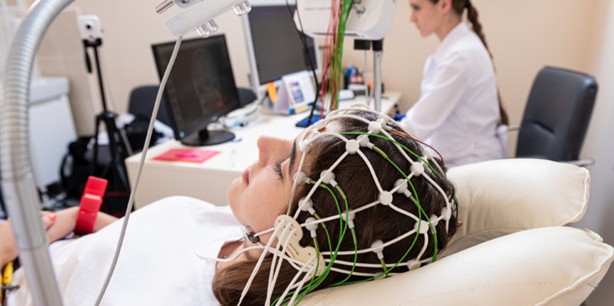
So, what can brain waves tell us about what is happening during the different sleep stages? First, let’s address how researchers are able to visualize the brain waves that occur in our daily lives and during sleep. One of the commonly used ways researchers will look at brain waves during sleep is by using an imaging method called electroencephalography, or more frequently referred to as EEG, shown in Figure 3. In order to visualize brain waves, an EEG is used to record the waves that the brain produces. When neurons communicate, the EEG records the entire shape and length of the wave produced by brain cells to visualize where, when, and how high the waves in the brain are. The height of the wave can tell researchers how strongly neurons need to communicate in order to accomplish a specific internal or external action. For example, if tasked with simply pressing a button when a specific word appears, and the participant’s brainwaves appear higher every time they press the button compared to when they do not, this suggests to researchers that more effort or communication between neurons was necessary to carry out that specific action. To record the waves the brain produces, an EEG is made up of little discs called electrodes that are spread across the surface of an individual’s scalp. These discs are all together on a cap, similar to a swimmer’s cap, and are connected to one recording point, like a computer. Each disc records the wave produced in the brain at the disc’s specific site location. EEG is used during sleep studies to record the changes in waves between the sleep stages (13,14).
EEG sleep studies can tell us about the significance of each sleep stage within a sleep cycle and further reiterate the importance of sleeping long enough to reach the later sleep stages. During the N3 and REM sleep stages of the sleep cycle, the brain undergoes memory consolidation. This means that memories that have been gathered during wake periods are moved from short-term to long-term memory. This way, they can be accessed and used again later when necessary. Essentially, your brain stores the events and things you learned throughout the day to allow you to recall them later on. Researchers are able to conclude that this process occurs during N3 and REM by using an EEG during sleep. While asleep in the N3 stage, the brain is consolidating facts and information gathered throughout the day, while during REM sleep, the brain is storing learned skills and emotional events(15,16). In addition to memory consolidation, EEG research has found that during the N3 sleep stage, the brain is undergoing a process to clear excess waste that is built throughout the day(17,18,19). Think of it as the day progresses, and you are completing more tasks and fulfilling more actions, each step leads to waste development within the brain(20). By the end of the day, the brain needs a fresh start, so to do so, it stores the important information through memory consolidation and clears the excess during a restful night’s sleep. Each of these processes briefly sheds light on the overall purpose of quality sleep. In this case, quality sleep would be met when all sleep stages occur several times a night, or a sleep cycle occurs four to six times a night. If rest does not occur or is interrupted, the brain is limited in its full ability to store information and clear waste. On the day following a night without sleep, the brain cannot fully operate to its full extent. Later on, you may forget things you learned in a day when you did not sleep, and you may struggle to understand new concepts or ideas.
Why Routine Matters
One of the easiest ways to get good quality sleep is to build a good routine. Simply put, going to bed at the same time every night and waking up at the same time every day(21). While this may sound simple, it is a commonly ignored or often sacrificed step of the sleep routine. Let’s break down why this part of sleep might be so important. Throughout the day, your body and brain carry out a series of functions on a 24-hour cycle; these functions can be referred to as circadian rhythms, as circadian means about one day.
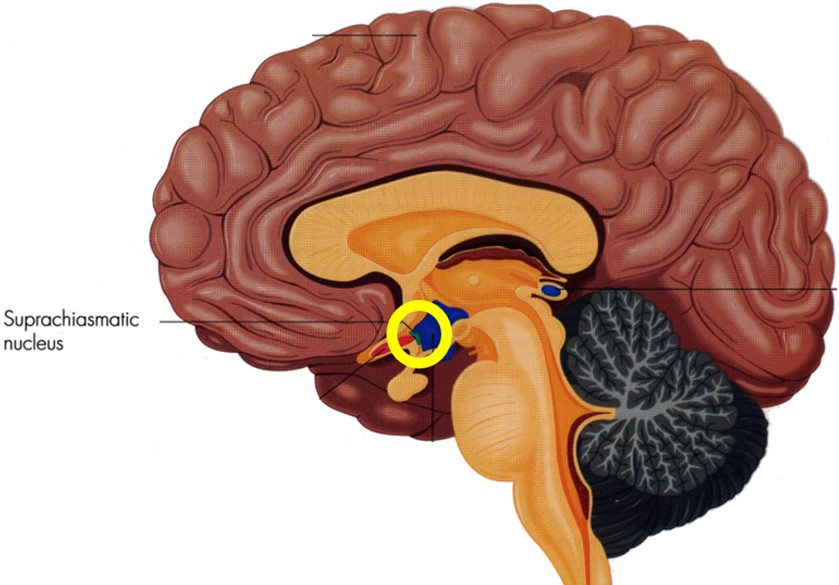
The brain region responsible for these rhythms is called the suprachiasmatic nucleus (SCN)(22,23). The SCN is involved in the 24-hour processes that occur throughout your body based on internal and external factors, leading to changes in sleep, mood, and hunger levels. The SCN is located in the middle bottom section of your brain, as shown in Figure 4. It sits above the part of your brain that cross-connects the visual input from your eyes, and the area responsible for secreting hormones. Cells located at the back of the eye form a tract, almost like a road, that connects the eyes to the SCN, typically sending light input to the brain. A separate road is responsible for sending a combination of both light and movement signals to the brain. Essentially, both roads are used to send your brain information about when light is or is not present and whether you are moving or not (24). Once the SCN is aware of the amount of light and movement around you, it uses that information to tell the Pineal gland if it needs to release melatonin, the sleep hormone. Lack of sleep or ignoring the SCN’s signals confuses the SCN, making it unable to effectively carry out its function, leading to impaired sleep/wake cycles. Essentially, the SCN loses its synchronization to typical light and dark signals if a lack of sleep occurs. This causes you to feel more tired throughout the day, shortening sleep cycles, also impacting your emotions and mental health. Additionally, it reduces the brain and body’s ability to carry out life-sustaining functions, knowledge and understanding, and transferring food into energy (25). So, by ignoring the SCN’s signals, you are not allowing your body to carry out its natural functions and limiting your ability to actively function throughout the day. Over time, disruptions to these functions can lead to new health issues (26). By building a routine based around typical light and dark cycles, you ensure that you are responding to your SCN’s natural signals that boost your brain and body’s ability to function.
Sleep Tips
For quality sleep, completing several sleep cycles and sleeping during the night are simple strides to feeling well-rested in the morning. You can take a series of extra steps to ensure you are getting quality sleep. In addition to receiving light signals from the sun, your eyes send light signals produced from your phone or computer screens to the SCN. The light signals produced by technology wrongly inform your brain that it is daytime. This reduces the amount of melatonin produced at night, making it more difficult to both fall asleep and stay asleep (27). A new step to ensure quality sleep is to limit screen time before bed. In fact, at any point where you are in bed, do not use your phone or computer; reserve your bed for sleeping alone. Instead of being on your phone before bed, try implementing relaxing methods that calm your body to prepare it for sleep. You could do some light reading, stretches, or journaling. Furthermore, to not confuse the SCN by sending it false light-signals, sleep in a dark room. To ease into the sleep stages, a quiet and cold room is best. As your body temperature naturally lowers before sleep, having a cool room can start this process early. During the N1 sleep phase, you are more likely to wake up, so having a quiet room is best for an undisturbed start to sleep. An interesting way to ensure that during sleep, your brain oscillates between sleep stages is to listen to white noise as you sleep. Studies have found that when listening to white noise, your brain almost syncs to the rhythms produced by the audio and mimics it by producing the same waveforms in brain waves(28). Additionally, introducing light music before bed can also improve sleep quality(29). Achieving quality sleep is not as difficult as it may seem; it is also more important than you may have expected. By introducing a simple routine that includes limited screen time, and possibly white noise or music, you can better ensure that you are at your best functioning self every day. Sleep is an often-overlooked aspect of life that can be developed to improve your day-to-day life.
References
- Feinberg, I., & Floyd, T. C. (1979). Systematic trends across the night in Human sleep cycles. Psychophysiology, 16(3), 283–291. https://doi.org/10.1111/j.1469-8986.1979.tb02991.x
- Malik, J., Lo, Y.-L., & Wu, H. (2018). Sleep-wake classification via quantifying heart rate variability by convolutional neural network. Physiological Measurement, 39(8), 085004. https://doi.org/10.1088/1361-6579/aad5a9
- Patel AK, Reddy V, Shumway KR, et al. Physiology, Sleep Stages. [Updated 2024 Jan 26]. In: StatPearls [Internet]. Treasure Island (FL): StatPearls Publishing; 2026 Jan-. Available from: https://www.ncbi.nlm.nih.gov/books/NBK526132/
- Stages of sleep. Kaiser Permanente. (n.d.). https://healthy.kaiserpermanente.org/health-wellness/health-encyclopedia/he.stages-of-sleep.hw48331
- Kim, T. W., Jeong, J.-H., & Hong, S.-C. (2015). The impact of sleep and circadian disturbance on hormones and metabolism. International Journal of Endocrinology, 2015, 1–9. https://doi.org/10.1155/2015/591729
- KIRJAVAINEN, T., COOPER, D., POLO, O. and SULLIVAN, C. (1996), Respiratory and body movements as indicators of sleep stage and wakefulness in infants and young children. Journal of Sleep Research, 5: 186-194. https://doi.org/10.1046/j.1365-2869.1996.t01-1-00003.x
- Brooks, P. L., & Peever, J. H. (2012). Identification of the transmitter and receptor mechanisms responsible for REM sleep paralysis. Journal of Neuroscience, 32(29), 9785–9795. https://doi.org/10.1523/jneurosci.0482-12.2012
- Carr, M., & Nielsen, T. (2015). Daydreams and nap dreams: Content comparisons. Consciousness and Cognition, 36, 196–205. https://doi.org/10.1016/j.concog.2015.06.012
- Siclari, F., Bernardi, G., Cataldi, J., & Tononi, G. (2018). Dreaming in NREM sleep: A high-density EEG study of slow waves and spindles. The Journal of Neuroscience, 38(43), 9175–9185. https://doi.org/10.1523/jneurosci.0855-18.2018
- Leavitt, J. (2026, January 23). How much deep, light, and REM sleep do you need?. Healthline. https://www.healthline.com/health/how-much-deep-sleep-do-you-need#stages-of-sleep
- Jee S. (2021). Brain Oscillations and Their Implications for Neurorehabilitation. Brain & NeuroRehabilitation, 14(1), e7. https://doi.org/10.12786/bn.2021.14.e7
- Vijayan, S., Lepage, K. Q., Kopell, N. J., & Cash, S. S. (2017). Frontal beta-theta network during REM sleep. eLife, 6, e18894. https://doi.org/10.7554/eLife.18894
- Dijk, D.-J. (1995). EEG slow waves and sleep spindles: Windows on The sleeping brain. Behavioural Brain Research, 69(1–2), 109–116. https://doi.org/10.1016/0166-4328(95)00007-g
- Huang, H., Zhang, J., Zhu, L., Tang, J., Lin, G., Kong, W., Lei, X., & Zhu, L. (2021). EEG-Based Sleep Staging Analysis with Functional Connectivity. Sensors (Basel, Switzerland), 21(6), 1988. https://doi.org/10.3390/s21061988
- HOLZ, J., PIOSCZYK, H., FEIGE, B., SPIEGELHALDER, K., BAGLIONI, C., RIEMANN, D., & NISSEN, C. (2012). Eeg Sigma and slow‐wave activity during NREM sleep correlate with overnight declarative and procedural memory consolidation. Journal of Sleep Research, 21(6), 612–619. https://doi.org/10.1111/j.1365-2869.2012.01017.x
- Wagner, U., & Born, J. (2008). Memory consolidation during sleep: Interactive effects of sleep stages and HPA regulation: Review. Stress, 11(1), 28–41. https://doi.org/10.1080/10253890701408822
- Jiang-Xie, LF., Drieu, A., Bhasiin, K. et al. Neuronal dynamics direct cerebrospinal fluid perfusion and brain clearance. Nature 627, 157–164 (2024). https://doi.org/10.1038/s41586-024-07108-6
- Semyachkina-Glushkovskaya, O., Fedosov, I., Penzel, T., Li, D., Yu, T., Telnova, V., Kaybeleva, E., Saranceva, E., Terskov, A., Khorovodov, A., Blokhina, I., Kurths, J., & Zhu, D. (2023). Brain Waste Removal System and Sleep: Photobiomodulation as an Innovative Strategy for Night Therapy of Brain Diseases. International journal of molecular sciences, 24(4), 3221. https://doi.org/10.3390/ijms24043221
- Wafford, K. A. (2021). Aberrant waste disposal in neurodegeneration: Why improved sleep could be the solution. Cerebral Circulation – Cognition and Behavior, 2, 100025. https://doi.org/10.1016/j.cccb.2021.100025
- Vijayakrishnan Nair, V., Kish, B. R., Chong, P. L., Yang, H. S., Wu, Y. C., Tong, Y., & Schwichtenberg, A. J. (2023). Neurofluid coupling during sleep and wake states. Sleep medicine, 110, 44–53. https://doi.org/10.1016/j.sleep.2023.07.021
- Mayo Foundation for Medical Education and Research. (n.d.). Sleep tips: 6 steps to better sleep. Mayo Clinic. https://www.mayoclinic.org/healthy-lifestyle/adult-health/in-depth/sleep/art-20048379
- Angeles-Castellanos, M., Salgado-Delgado, R., Rodriguez, K., Buijs, R. M., & Escobar, C. (2010). The suprachiasmatic nucleus participates in food entrainment: A lesion study. Neuroscience, 165(4), 1115–1126. https://doi.org/10.1016/j.neuroscience.2009.11.061
- Ma MA, Morrison EH. Neuroanatomy, Nucleus Suprachiasmatic. [Updated 2023 Jul 24]. In: StatPearls [Internet]. Treasure Island (FL): StatPearls Publishing; 2026 Jan-. Available from: https://www.ncbi.nlm.nih.gov/books/NBK546664/
- Biello, S. M., Harrington, M. E., & Mason, R. (1991). Geniculo-hypothalamic tract lesions block chlordiazepoxide-induced phase advances in Syrian hamsters. Brain Research, 552(1), 47–52. https://doi.org/10.1016/0006-8993(91)90658-i
- Deboer, T., Détári, L., & Meijer, J. H. (2007). Long term effects of sleep deprivation on the mammalian circadian pacemaker. Sleep, 30(3), 257–262. https://doi.org/10.1093/sleep/30.3.257
- Du, T., Liu, S., Yu, H., Hu, T., Huang, L., Gao, L., Jia, L., Hu, J., Yu, Y., & Sun, Q. (2024). Chronic sleep deprivation disturbs energy balance modulated by suprachiasmatic nucleus efferents in mice. BMC Biology, 22(1). https://doi.org/10.1186/s12915-024-02097-4
- Riemersma, R. F., Mattheij, C. A. M., Swaab, D. F., & Van Someren, E. J. W. (2004). Melatonin rhythms, melatonin supplementation and sleep in old age. NeuroImmune Biology, 195–211. https://doi.org/10.1016/s1567-7443(04)80014-0
- Ebben, M. R., Yan, P., & Krieger, A. C. (2021). The effects of white noise on sleep and duration in individuals living in a high noise environment in New York City. Sleep medicine, 83, 256–259. https://doi.org/10.1016/j.sleep.2021.03.031
- Yan, D., Wu, Y., Luo, R., & Yang, J. (2024). Bedtime music therapy for college students with insomnia: A Randomized Assessor-Blinded Controlled Trial. Sleep Medicine, 121, 326–335. https://doi.org/10.1016/j.sleep.2024.07.018