
The Science of Attention and How to Improve It
You sit down. It’s time to lock in and get these assignments done. Within seconds, your phone screen lights up. A notification, you check it ‘quickly’ and the next thing you know, you’ve been mindlessly scrolling for twenty minutes. You try to go back to your task, but after rereading the same sentence five times and retaining nothing, you go back to your phone. It’s not just you. This is becoming the default experience of attention in modern life.
A 2022 study by King’s College London found that nearly half of the UK public (49%) feel their attention span is shorter than it used to be (1). We see it everywhere. Children are being raised on tablets, jumping from one stimulus to the next. Adults are continually bombarded with emails, texts, news updates, and social media alerts; It’s never-ending. We live in an environment that is engineered to capture our attention in every direction simultaneously. The result is a noticeable shift: focusing feels harder, distractions are ever-present, and mental fatigue sets in faster than it used to.
It’s easy to interpret this as a personal failure. People often say, “I have a short attention span,” but that explanation is incomplete and misleading. Attention is not a skill. It is a complex neurological system that decides what you notice, what you ignore, and how you engage with stimuli. Whenever you resist distractions, switch tasks, or try to concentrate in a noisy environment, this system is at work. That leads to a crucial idea.
Attention is trainable.
It is not a fixed ability determined by genetics or circumstance. Attention behaves similarly to a muscle. It strengthens with use, adapts to demands, and weakens with neglect. If your daily environment requires constant switching of multitasking, your brain becomes more efficient at switching. If you rarely sustain attention for long periods, your ability to do so decreases. On the other hand, when you deliberately practice deep focusing and challenge your mind, the underlying neuronal systems adjust and improve.
Perspective changes the conversation. Instead of asking “Why can’t I focus?” the question becomes, “What has my brain been trained to do?”
To answer that question, we need to understand how attention works and how it connects directly to everyday experiences. What is happening in your brain when a notification pulls you away from a task? Why does it feel harder to concentrate as you get older? How can you train your attention effectively?
How Does Attention Work?
Attention is defined as a set of complex psychological functions that include focusing or engaging with a goal, enduring, and being alert for a long time (2). It is our awareness of what is happening around us. We are surrounded by vast amounts of information and stimulus available to the senses, stored memory, and cognitive processes. Attention sorts that information and allows a very limited amount to be actively processed. Without it, every day would be a sensory overload.
The attention control system is one of the most complex control procedures in our nervous system. At the highest level, attention relied on three core processes: selection, maintenance, and control. These processes occur continuously and often automatically, shaping how attention is directed and sustained.
Selection, or selective attention, refers to the ability to choose what information to focus on. You might be familiar with the joke “My husband has selective hearing.” It’s very similar for attention. Selection allows relevant information to be prioritized while irrelevant input is filtered out. For example, when reading, selection enables you to focus on the text rather than the surrounding noise or visual distractions. The lack of effective selection causes scattered attention or ‘scatter brain.’ Selection exhibits protracted development, meaning young children are significantly worse at filtering out tasks or goal-relevant information. This results in them processing more information than is required (3) and less efficient processing of relevant information (4).
Maintenance is the ability to sustain attention on a chosen stimulus over time. This allows for continued engagement with a task, such as studying, writing a paper, or completing a project. When maintenance weakens, attention drifts, leading to interruptions in comprehension and performance.
Control involves managing distractions and shifting attention when necessary. It allows you to resist irrelevant stimuli, suppress impulses, and redirect focus when priorities change. Control is essential for functioning in dynamic environments. It ensures that attention remains flexible rather than rigid. When control is compromised, distractions become more difficult to ignore, and returning to a task after interruption becomes more challenging (5).
Attention Networks and Pathways
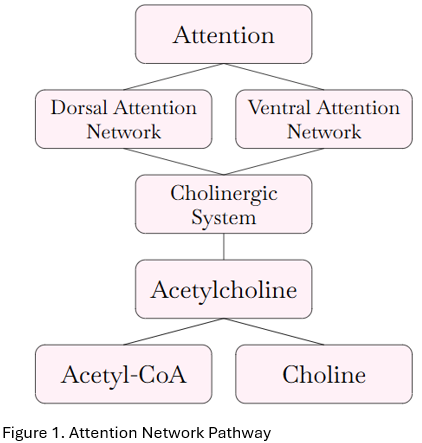
Attention pathways can be separated into two networks, the Dorsal Attention Network (DAN) and Ventral Attention Network (VAN). These networks work together to balance sustained focus with environmental awareness.
DAN is responsible for top-down or goal-oriented attention. This network is active when attention is intentionally directed toward a task. It is primarily composed of regions in the frontal and parietal lobes, areas associated with planning, decision-making, and spatial awareness. For example, when studying, DAN prioritizes processing visual text, reducing interferences from background distractions so tasks can be completed with greater efficiency.
In contrast, VAN is responsible for bottom-up or stimulus-driven attention.
This network, located in the part of the brain that is a key hub for integrating visual and spatial information, activates automatically in response to changes in the environment, like sudden sounds or movement. VAN interrupts ongoing focus and redirects attention to the new stimulus, so its importance can be evaluated. It plays a crucial role in adaptive behavior by ensuring that environmental changes are not overlooked. An example is a notification chime from your phone (6; 7).
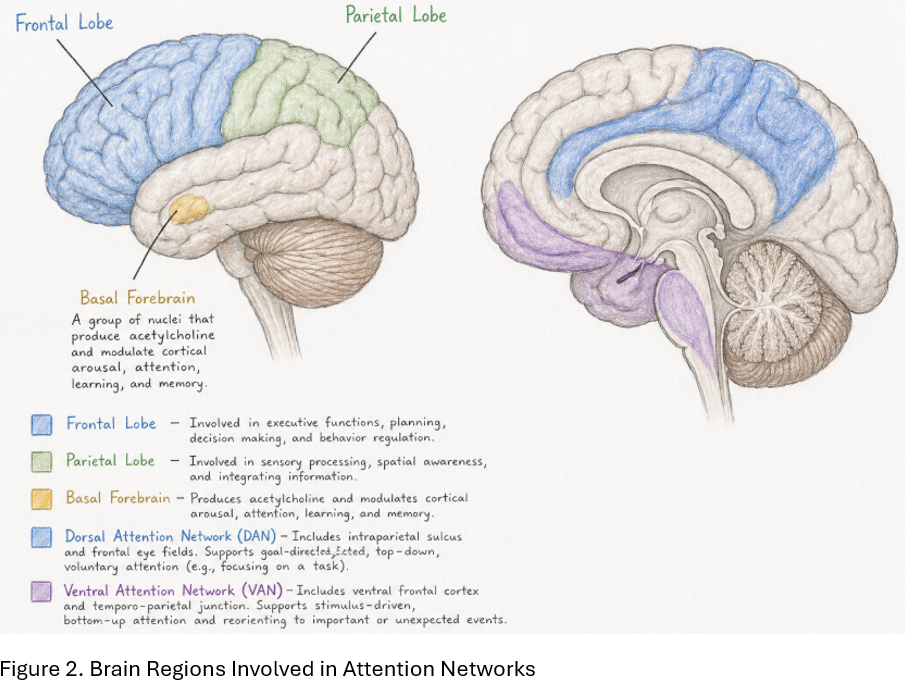
Attention depends on the interaction between DAN and VAN. These networks balance sustained focus and environmental awareness, allowing us to effectively manage attention. For example, when watching a movie, DAN sustains focus on the movie while VAN alerts you to the incoming pillow your friend threw at you. DAN and VAN work together to guide focus and monitor the environment. These systems are supported by neurochemical regulation, particularly through the cholinergic system.
Cholinergic System and ACh: Supporting Focus
In addition to attention networks, focus depends on chemical systems that regulate neural communication. One of the most important is the cholinergic system. The cholinergic system is a network of neurons that relies on the neurotransmitter acetylcholine (ACh). Neurotransmitters are chemical messengers that allow neurons to communicate.
The cholinergic system originates largely in the basal forebrain, located at the base of the frontal lobe. It is strongly involved in sustained attention, or the ability to remain focused over time (8). It also contributes to learning and memory because the brain is more likely to remember information that receives focused attention. This is why concentration and memory are so closely linked. If attention is weak, memory formation is often weak as well.
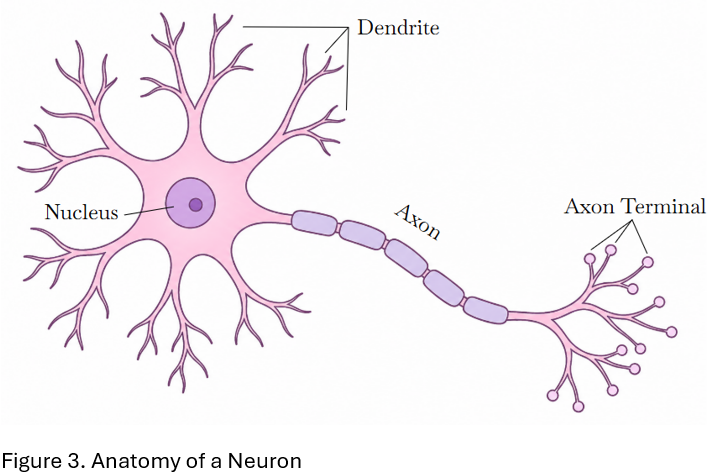
Let’s start with a quick overview of the neuron. You can think of a neuron like your arm. The beginning of the neuron, or the dendrite, would be your elbow, and the axon terminal would be your fingers. Electrical signals are sent from the dendrite to the axon terminal. The point where the axon terminal of the first neuron, also called the presynaptic neuron, meets the dendrite of the second neuron, or post-synaptic neuron, is called the synapse. This is where we see the majority of ACh activity.
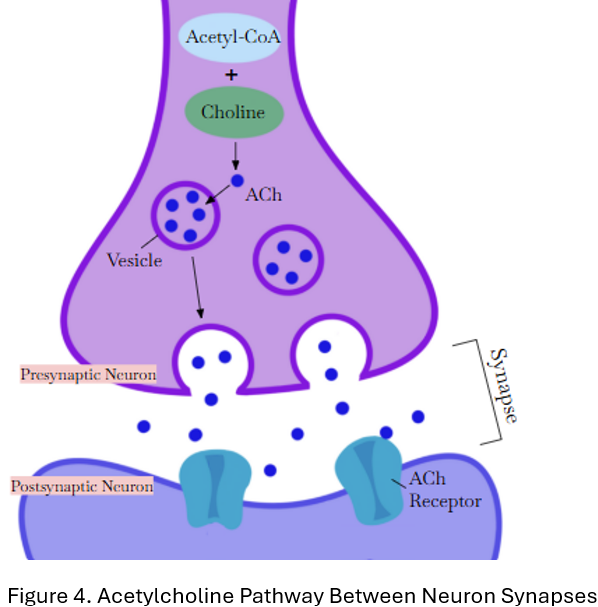
ACh is synthesized in the neuron through the combination of two enzymes, Acetyl-CoA and Choline. These two enzymes are produced within the body, where they then combine in the axon terminals. The ACh is then loaded into vesicles within the axon terminal. Vesicles are like the mail trucks of the neuron. They package neurotransmitters and ship them out to the synapse, where the neurotransmitters are released. On the postsynaptic neuron, you have ACh receptors. ACh in the synapse will bind to these receptors and cause changes to the postsynaptic neuron. This is how neurons communicate with each other and send signals. The presynaptic neuron releases neurotransmitters or signal, which is relayed across the synapse to the postsynaptic cell via the receptors (8;9). When ACh binds to the receptors, this accelerates information transmission across neurons, enhancing memory ability and cognitive function. This is why fatigue can feel like it steals your mental energy. Sleep deprivation and chronic stress interfere with systems that regulate ACh, making attention noticeably worse. ACh is imperative to our daily functioning.
Aging and Attention
Attention is not a single ability. It includes several skills: sustaining focus over long periods of time, muting distractions, multitasking, and responding quickly to important and relevant information. Changes in attention are common as we get older; however, whether those changes are positive or negative varies. Many but not all cognitive abilities decline during aging. Some actually improve.
How exactly do scientists test attention span? Well, there are multiple ways. One of the oldest and most common is the digit span test. A person hears or sees a list of numbers such as 4 – 9 – 3. They must repeat the numbers back correctly. Then the list gets longer, 7 – 1 – 5 – 8. The test continues until the numbers become too hard to remember. If someone can remember 10 digits in a row, their digit span is 10.
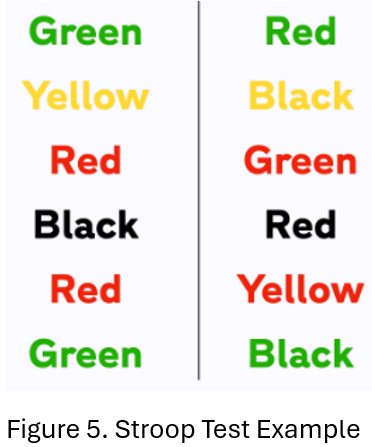
Another widely used measure is the Stroop Test. In this case, color words such as “red” or “yellow” are shown in conflicting colors. For example, the word red may be in green. The participant must name the ink color rather than read the word. This requires suppressing the automatic tendency to read, making this a useful measure of inhibitory control and attention.
Researchers also use reaction times to test attention consistency. Participants respond as quickly as possible to visual or auditory cues. Slower or more variable results can indicate attention deficits (10).
As we age, studies have shown changes in our frontal and parietal brain regions. From adolescence to our mid-20s, activation of the frontal lobe during cognitive tasks increases. Remember, the frontal lobe is crucial in our decision making and attention span. On the other hand, older adults exhibit a decline in the number of neurons in the frontal lobe. Fewer neurons mean less neuronal communication, leading to a decline in cognitive function (11).
One of the most common changes in attention is the decline of perceptual processing speed. This refers to the ability to quickly and accurately process and interpret sensory information. Older adults require more time to respond to information, showing a decline in bottom-up visual processing at the sensory level, even when tested under best-corrected conditions (i.e., with glasses). In other words, older adults often process visual information more slowly. An example of bottom-up processing would be looking at a blurry image of a dog. Bottom-up processing would first detect the edges, shapes, and colors. These would gradually combine to form the recognizable image of a dog, even if it were incomplete. It took older adults more time to discern the image (12; 13; 14).
Another common change involves selective attention. Younger adults are faster than older adults in avoiding attentional capture by a noticeable but task-irrelevant item. As people age, they may become slower at ignoring distracting things and staying focused on what matters. This happens because the brain’s voluntary control of attention becomes weaker. represents a decline in top-down attention control (15; 16).
How Can I Exercise My Attention?
An important topic in neuroscience is the idea of neuroplasticity, or the brain’s ability to change its structure and function in response to experience. At the beginning, it was mentioned that attention is like a muscle. We need to exercise it in order to strengthen it. Neuroplasticity allows for strengthening or neural pathways when we use them repeatedly. Every time you practice focusing, resisting distraction, or sustaining concentration, you reinforce the circuits involved. This means attention can be trained in and into older adulthood just as physical strength can be improved later in life.
One of the simplest and most effective methods to train attention is to schedule focus sprints. This involves setting a certain length of time to work on one task, then following it up with a quick reset, allowing yourself to walk away mentally and physically before returning to the task. A common method is the 25-minute sprint followed by the 3–5-minute reset. Many people benefit from using focus apps or timers that block phone distractions and track work intervals. Sit up straight when working. A tall, relaxed posture can improve alertness and reduce mental drift.
During breaks, avoid scrolling on your phone. Instead, activate your other senses. Stand up, stretch, get water, or take a brief walk. Widen your gaze. When stressed or in deep focus, people tend to develop a narrow, tense field of visual attention. Ever heard of tunnel vision? By relaxing your eyes and taking in more of the peripheral visual field, you can reduce stress on your nervous system. This helps the brain reset rather than remain overstimulated.
An often-overlooked tool is slow breathing exercises like the ones used in meditation practices. Even 1-2 minutes of controlled breathing before beginning work can improve cognitive control by helping the mind settle and prepare for concentration. Think of your brain like a whiteboard. You are taking a few minutes to erase everything on the board so there is space for new and relevant information (17; 18).
It is also important to recognize that many states masquerade as poor attention. Hunger, sleep deprivation, dehydration, and stress can all feel like cognitive weakness when they are actually biological needs. Keeping track of the basics is just as important as exercise.
The most important lesson is that aging changes attention, but it does not eliminate the ability to improve it. Some slowing may occur, and distractions may feel stronger, but the brain remains adaptable. What often declines fastest is not attention itself, but the habit of challenging it. Aging may be inevitable, but cognitive stagnation is not. Remember, the goal is consistency, not perfection.
Citations:
- King’s College London. (2022, February 16). Are attention spans really collapsing? Data shows UK public are worried – but also see benefits from technology. Www.kcl.ac.uk. https://www.kcl.ac.uk/news/are-attention-spans-really-collapsing-data-shows-uk-public-are-worried-but-also-see-benefits-from-technology
- Shahmoradi, L., Mohammadian, F., & Rahmani Katigari, M. (2022). A systematic review on serious games in attention rehabilitation and their effects. Behavioural neurology, 2022(1), 2017975.
- Plebanek, D. J., & Sloutsky, V. M. (2017). Costs of selective attention: When children notice what adults miss. Psychological science, 28(6), 723-732.
- Sloutsky, V. M., & Fisher, A. V. (2008). Attentional learning and flexible induction: How mundane mechanisms give rise to smart behaviors. Child Development, 79(3), 639-651.
- Oberauer, K. (2019). Working Memory and Attention – A Conceptual Analysis and Review. Journal of Cognition, 2(1). https://doi.org/10.5334/joc.58
- Coll, S. Y., Marti, E., Naz Doganci, & Ptak, R. (2025). Functional Connectivity of the Dorsal and Ventral Attention Network and Its Role in Attentional Disengagement. Brain and Behavior, 15(10). https://doi.org/10.1002/brb3.70868
- Alves, P. N., Forkel, S. J., Corbetta, M., & Thiebaut de Schotten, M. (2022). The subcortical and neurochemical organization of the ventral and dorsal attention networks. Communications Biology, 5(1). https://doi.org/10.1038/s42003-022-04281-0
- Huang, Q., Liao, C., Ge, F., Ao, J., & Liu, T. (2022). Acetylcholine Bidirectionally Regulates Learning and Memory. Journal of Neurorestoratology, 10(2). https://doi.org/10.1016/j.jnrt.2022.100002
- Hedges, V. (2022). Neurotransmitters: Acetylcholine. Openbooks.lib.msu.edu. https://openbooks.lib.msu.edu/introneuroscience1/chapter/neurotransmitter-synthesis-storage-and-receptors-acetylcholine/
- How to Test Your Attention Span: Methods That Work. (2026, April 27). ScienceInsights. https://scienceinsights.org/how-to-test-your-attention-span-methods-that-work/
- Robison, M. K., Diede, N. T., Nicosia, J., Ball, B. H., & Bugg, J. M. (2022). A multimodal analysis of sustained attention in younger and older adults. Psychology and Aging, 37(3), 307–325. https://doi.org/10.1037/pag0000687
- Madden, D. J., Whiting, W. L., Cabeza, R., & Huettel, S. A. (2004). Age-Related Preservation of Top-Down Attentional Guidance During Visual Search. Psychology and Aging, 19(2), 304–309. https://doi.org/10.1037/0882-7974.19.2.304
- Vallesi, A., Tronelli, V., Lomi, F., & Pezzetta, R. (2021). Age differences in sustained attention tasks: A meta-analysis. Psychonomic Bulletin & Review, 28(6). https://doi.org/10.3758/s13423-021-01908-x
- Madden, D. J. (2007). Aging and Visual Attention. Current Directions in Psychological Science, 16(2), 70–74. https://doi.org/10.1111/j.1467-8721.2007.00478.x
- Colcombe, A. M., Kramer, A. F., Irwin, D. E., Peterson, M. S., Colcombe, S., & Hahn, S. (2003). Age-related effects of attentional and oculomotor capture by onsets and color singletons as a function of experience. Acta Psychologica, 113(2), 205–225. https://doi.org/10.1016/s0001-6918(03)00019-2
- Briggs, F., Mangun, G. R., & Usrey, W. M. (2013). Attention enhances synaptic efficacy and the signal-to-noise ratio in neural circuits. Nature, 499(7459), 476–480. https://doi.org/10.1038/nature12276
- Brain, V. B. (2025, September 2). Aging and Attention: Gentle Brain Fitness for Midlife Clarity – Very Big Brain. Very Big Brain. https://verybigbrain.com/cognitive-decline/aging-and-attention-gentle-brain-fitness-for-midlife-clarity/
- 6 Simple Science-Backed Ways To Boost Your Attention Span. (2024). Sciencefocus.com. https://www.sciencefocus.com/the-human-body/science-attention-span